Regulatory Velocity is Increasing
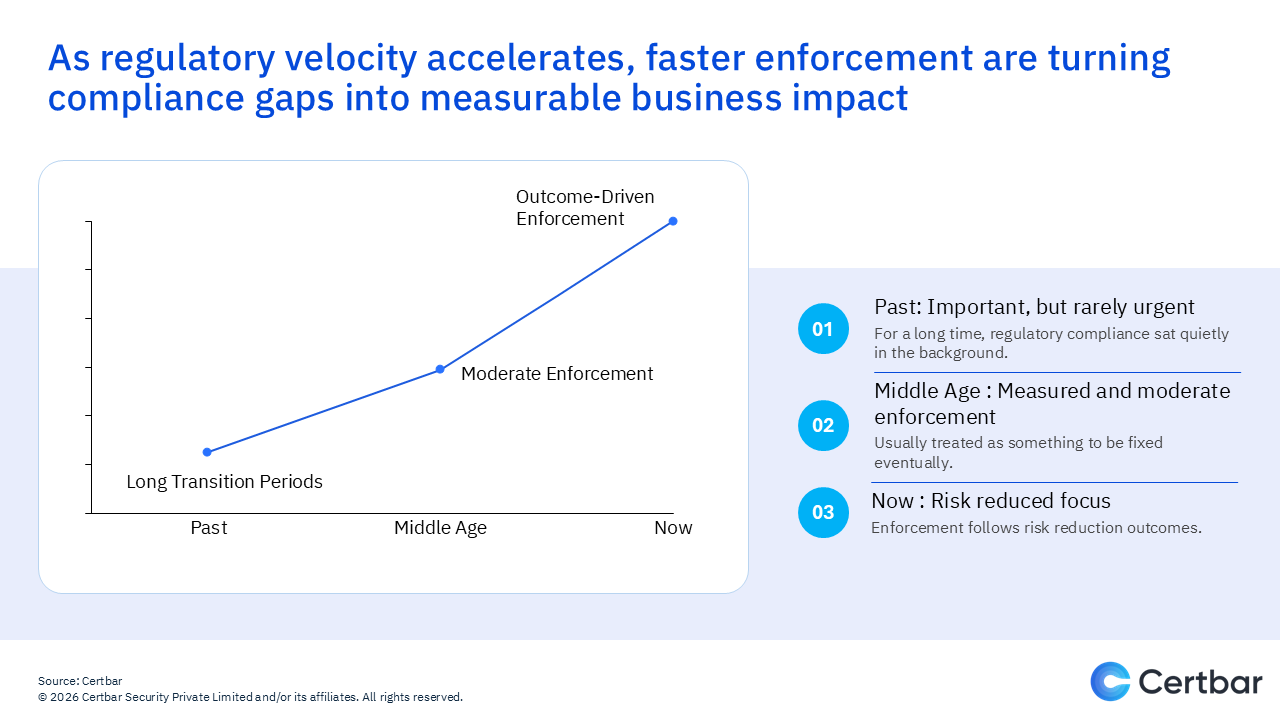
For a long time, regulatory compliance sat quietly in the background.
Important, but rarely urgent. Often delegated.
Usually treated as something to be fixed eventually. That era is over.
Today, regulatory timelines are shrinking, enforcement is tightening, and non-compliance is directly translating into business disruption, revenue loss, and reputational damage. What was once viewed as a compliance issue has become a core business risk.
Most organizations did not change their compliance operating models when regulations sped up. They kept the same assumptions: more time, more warnings, gradual enforcement.
What changed was not intent, but what changed was the cost of being late.
Compliance Mindset Shift : Then vs Now
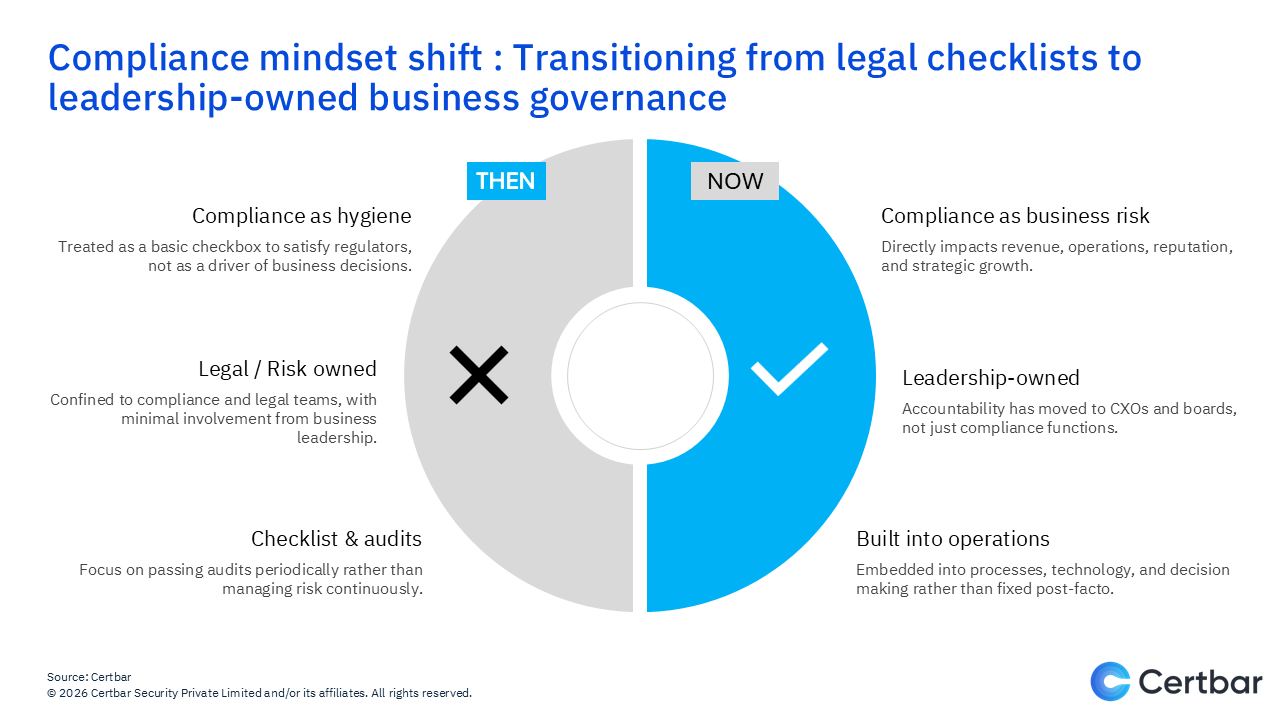
For years, compliance entered the picture after business decisions were already made. It showed up during audits, reviews, or when an issue demanded explanation. As long as policies existed and reports were filed, risk was assumed to be under control.
Today, that assumption no longer holds.
Compliance now sits closer to the front line. Leadership is expected to answer questions in real time, where critical data resides, how it moves, and whether controls will hold up under immediate scrutiny. The focus has shifted from intent to outcomes, from documentation to operational proof.
This is the real mindset shift. Compliance is no longer about having time to respond; it is about being ready at any moment. And organizations that still operate with the old assumptions are discovering that regulatory pressure no longer waits for them to catch up.
Recent regulatory actions in India clearly reflect this shift.
Cases such as IndiGo and FDTL show that regulatory non-compliance no longer results in warnings or corrective paperwork alone. Instead, the outcomes are increasingly tangible and immediate:
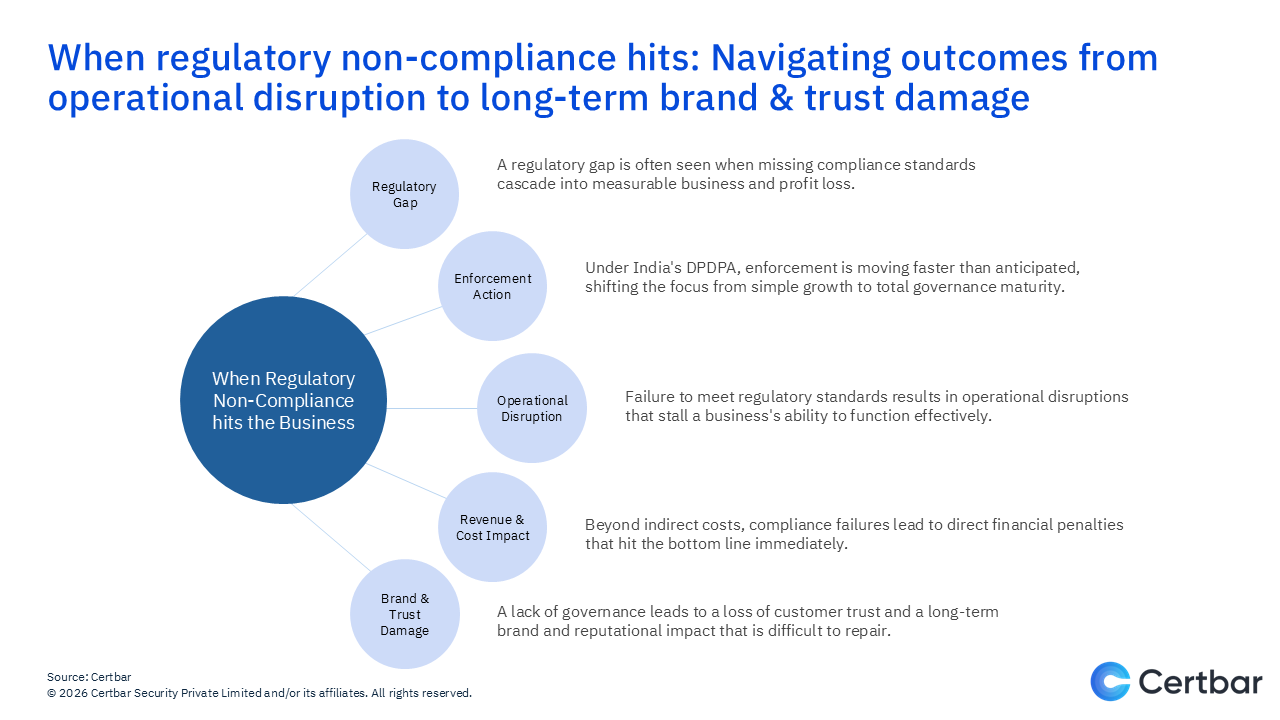
- Operational disruptions
- Loss of customer trust
- Direct financial penalties
- Long-term brand and reputational impact
These are not checklist failures. They are outcome-driven failures, where regulatory gaps cascade into measurable business and profit loss.
As a result, leadership teams are now being held accountable not just for growth, but for governance maturity.
At the same time, India’s Digital Personal Data Protection Act (DPDPA) is moving faster than many organizations anticipated. While the DPDP Act originally allowed an 18-month transition period, recent regulatory signals and discussions indicate that this timeline may be reduced to 12 months. This change is proposed and not yet formally notified, but it reflects the direction of enforcement readiness.
DPDPA Timelines are Tightening
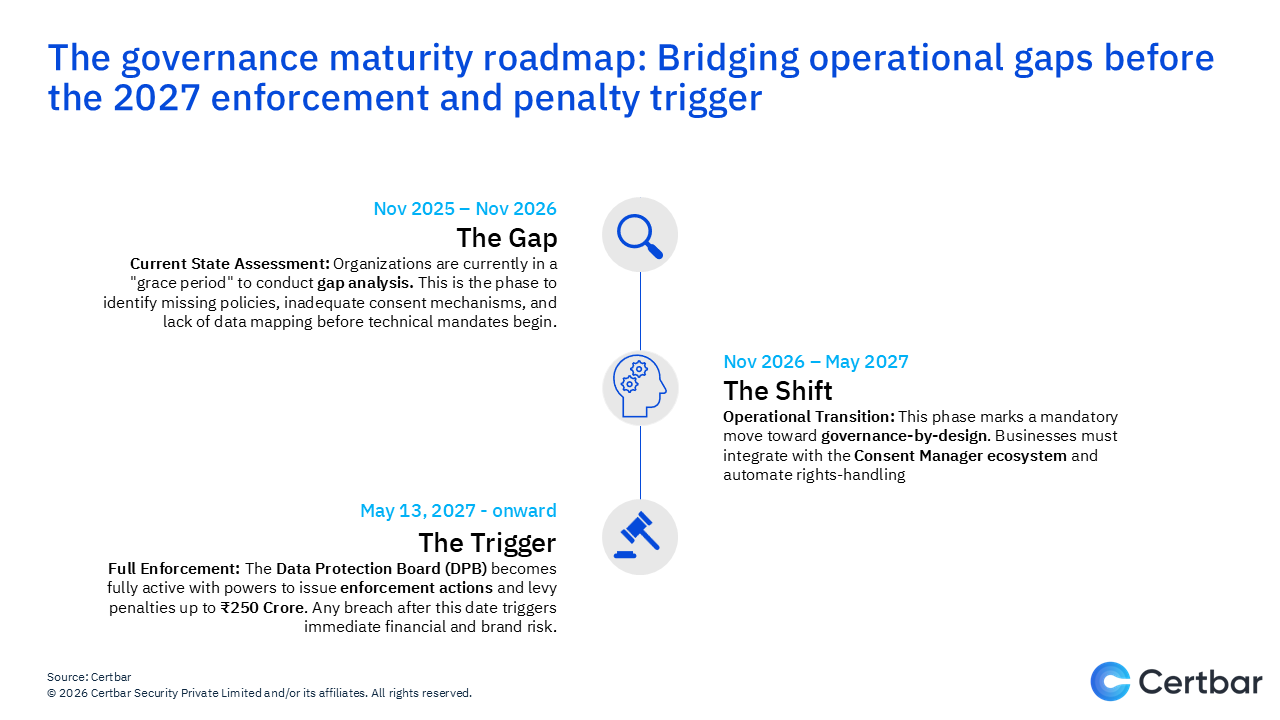
A key driver behind this acceleration is India’s effort to align its data protection and privacy framework with EU Free Trade Agreement expectations. This alignment is reshaping regulatory expectations across industries.
The implications are clear and increasingly difficult to ignore.
Transition windows are getting shorter, leaving little room for interpretation or phased implementation. Scrutiny on how organizations handle personal and sensitive data has intensified, with regulators expecting demonstrable control over data handling practices, consent mechanisms, breach preparedness and not promises or future plans. At the same time, global partners, regulators, and stakeholders are raising the bar, expecting Indian organizations to operate at international standards of data protection, governance, and operational readiness.
This shift changes the nature of leadership conversations.
The leadership question is no longer, “Do we have a roadmap?”
Roadmaps assume time.
The real question now being asked in leadership rooms is, “If regulatory expectations accelerate further, can we actually meet them within compressed timelines without slowing down operations, disrupting growth, or eroding trust?”
For many organizations, the honest answer remains uncertain.
Not because intent is missing, but because visibility is. Leaders often lack real-time clarity on where critical data resides, how it is sourced and shared, whether consent is consistently enforced, and whether breach response mechanisms can operate effectively under pressure. In an environment where timelines are shrinking, this uncertainty itself becomes a material business risk.
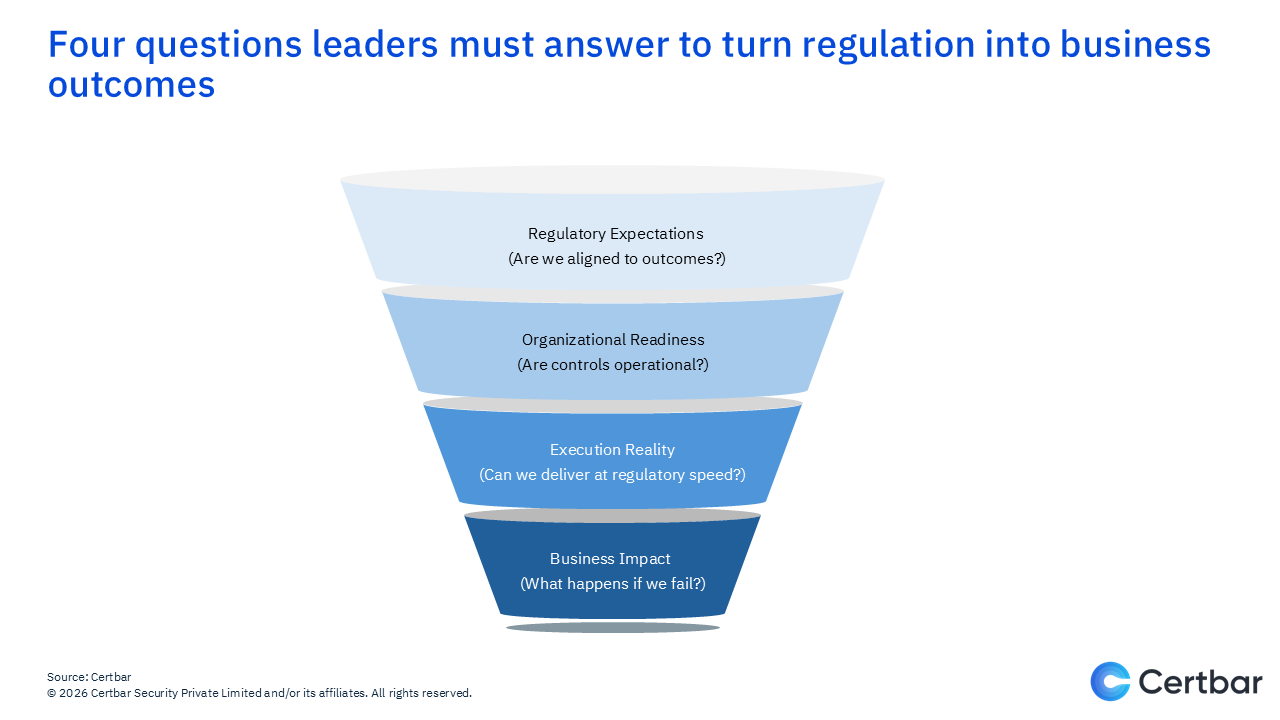
This uncertainty highlights a broader reality. Regulatory non-compliance today impacts far more than legal standing. It directly affects:
- Market access
- Partner confidence
- Customer trust
- Valuation and investor perception
In this environment compliance maturity has become a competitive advantage. While the DPDP Act originally allowed an 18-month transition period, recent regulatory signals and discussions indicate that this timeline may be reduced to 12 months. This change is proposed and not yet formally notified, but it reflects the direction of enforcement readiness.
Compliance Maturity as a Shared, Business-Owned Capablity
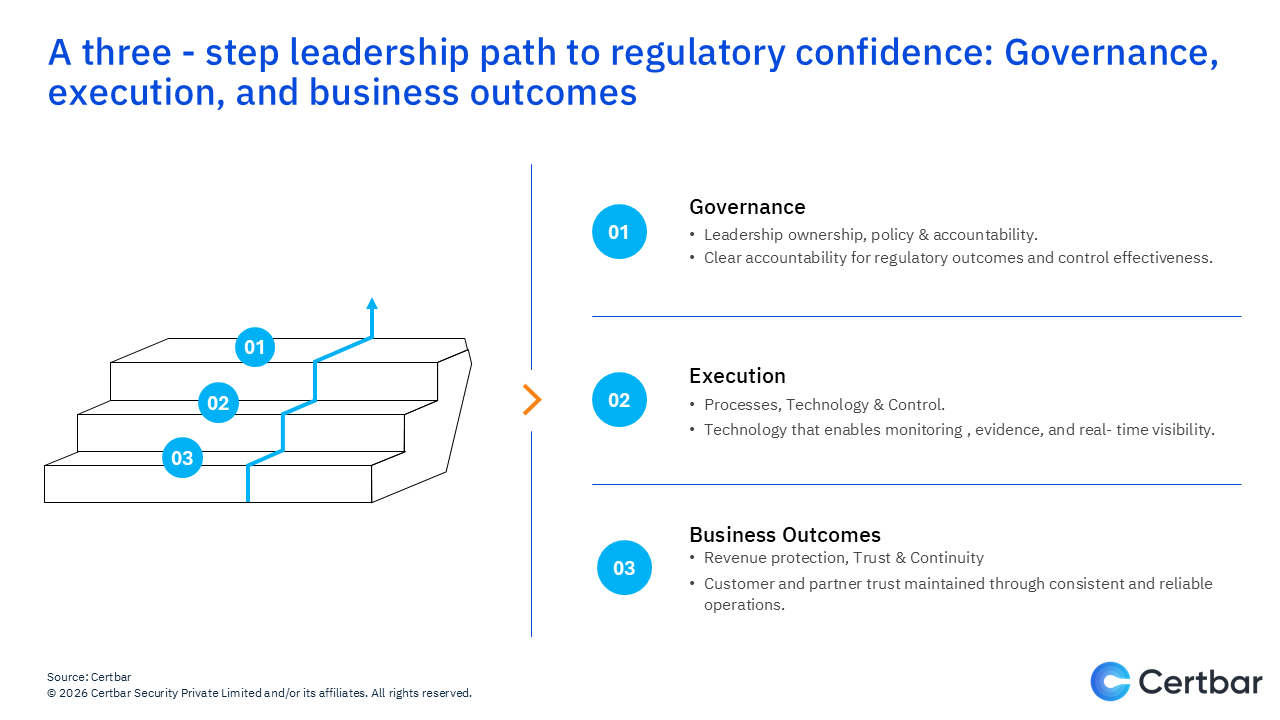
Organizations that treat compliance as a strategic capability, embedded into transformation initiatives, technology decisions, and operating models move faster, operate with greater resilience, and build lasting credibility.
Those that don’t risk learning the hard way that regulatory failure is no longer absorbed quietly in the background. It now shows up as a business consequence.
The leadership imperative is clear. The conversation must shift:
- From compliance as a cost → to compliance as risk management
- From post-facto fixes → to proactive governance
- From departmental ownership → to leadership accountability
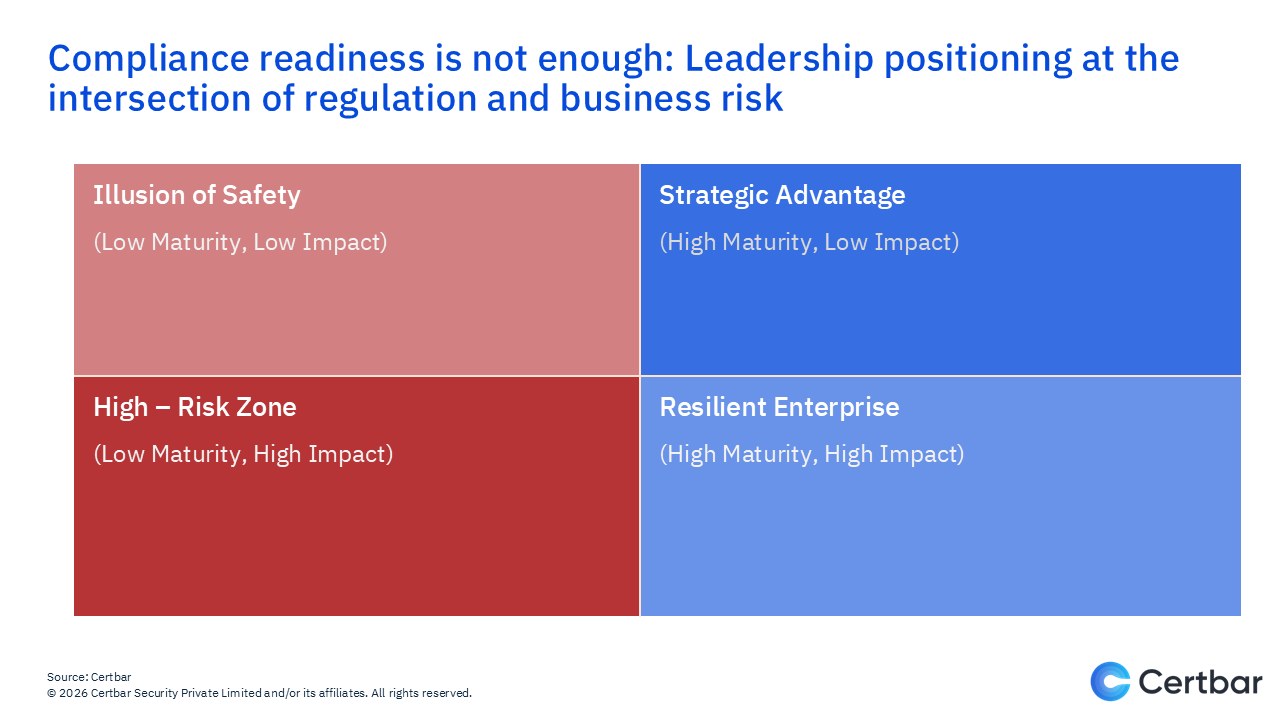
This matrix captures the leadership reality many organizations are now confronting. Low compliance maturity can create an illusion of safety when regulatory impact appears limited, but that stability is fragile. As timelines compress and enforcement accelerates, the same organizations quickly slip into the high-risk zone, where regulatory gaps translate into operational disruption, financial loss, and reputational damage.
By contrast, organizations that invest early in compliance readiness through clear data visibility, operational controls, and governance that functions at business speed reduce the impact of regulatory scrutiny and build resilience. At higher levels of maturity, compliance stops being a defensive measure and becomes a strategic advantage, enabling organizations to scale, partner globally, and operate with confidence under pressure.
Leadership positioning today is defined by where the organization sits on this curve and how quickly it can move.
Because in today’s regulatory climate, waiting is the biggest risk of all.
Frequently Asked Questions (FAQs)
1. What is the compliance timeline under India’s DPDP Act?
Under the Digital Personal Data Protection (DPDP) Act, organizations were initially expected to comply within an 18-month transition period. However, recent regulatory developments indicate that this timeline could potentially reduce to 12 months, subject to formal notification.
2. Has the DPDP compliance timeline officially been reduced to 12 months?
No, the reduction of the DPDP compliance timeline to 12 months has not yet been formally notified. Current discussions and regulatory signals suggest a possible shortening of timelines, indicating increased enforcement readiness.
3. Why is the DPDP compliance timeline expected to shrink?
Regulators are increasingly focused on faster enforcement, data protection readiness, and accountability. As organizations handle growing volumes of personal data, shorter timelines reflect expectations that compliance should be embedded into business operations rather than treated as a delayed exercise.
4. Which organizations are impacted by a shorter DPDP compliance timeline?
A shorter DPDP timeline impacts all organizations processing personal data, including startups, enterprises, and especially Significant Data Fiduciaries handling large volumes of sensitive or critical data.
5. What are the key compliance areas organizations should focus on under DPDP?
Organizations should prioritise:
- Personal data discovery and classification
- Consent management mechanisms
- Data principal rights handling
- Vendor and third-party risk management
- Breach detection and incident response readiness
These areas become more critical as compliance timelines compress.
6. How does a reduced DPDP timeline affect leadership and governance?
Compressed timelines increase leadership accountability. Boards and senior management are expected to demonstrate visibility into data risks, compliance progress, and enforcement preparedness — making DPDP compliance a strategic governance issue, not just a legal one.
7. How should organizations prepare for potential DPDP enforcement within 12 months?
Organizations should move early by:
- Conducting DPDP readiness assessments
- Embedding privacy-by-design into processes
- Aligning compliance initiatives with business priorities
- Avoiding last-minute, checklist-driven compliance approaches
Early preparation reduces operational disruption and regulatory risk.


Share